An AI End-State: What Messy Virgo Becomes
The real question behind Messy Virgo is not whether AI can improve crypto research or fund workflows. It is whether an AI-native, on-chain fund management platform can be built from first principles, with shared market memory, modular intelligence, auditable execution, and community-aligned value capture.
That is the end state worth building toward: not another dashboard, token, or set of disconnected trading tools, but a system in which AI agents, human judgment, on-chain execution, and governance work as a single operating model.
Structural Shift
A structural shift is underway. AI is changing what work exists, how organizations are designed, and how much leverage a single person can have when systems absorb routine analysis, coordination, and execution.
That same shift is arriving in markets. Traditional fund operations still rely on fragmented data, manual work, siloed research, slow handoffs, and static reports. Even many crypto projects that talk about AI still treat it as a thin feature layered onto old workflows rather than as the organizing principle of the organization itself.
Messy Virgo was created around a different assumption: the future of fund management belongs to small, high-agency teams supported by shared data infrastructure, modular intelligence systems, and increasingly autonomous execution rails.
What AI-Native Means
An AI-native fund platform does not bolt AI onto a terminal or chatbot. It builds every layer so that data, analysis, decision support, execution, reporting, and governance can all be understood, assisted, and eventually operated by intelligent systems under explicit constraints.
In practical terms, that means the system should know the token universe it is allowed to trade, the market conditions it operates in, the mandates it must obey, the signals it trusts, the risks it must avoid, and the governance boundaries it cannot cross.
In that design, humans still matter enormously. Their attention, however, is reserved for choosing objectives, defining rules, testing new edges, interpreting regime changes, and deciding how the system itself should evolve. Repetitive work, including screening, data preparation, monitoring, and explanation, shifts to the machine layer.
The End-State System
Messy Virgo already has the foundations of this architecture: a Market Data Hub, a modular Due Diligence Engine, live analytical lenses, test funds, and a phased path toward an autonomous fund agent and DAO-aligned platform.
The end-state is what those pieces become once fully integrated.

The Market Data Hub and Due Diligence Engine as one living, transparent intelligence layer.
Market Data Hub
In the end-state, the Market Data Hub is not just a bundle of APIs. It is a structured market memory that continuously ingests and organizes prices, liquidity, wallet activity, social flows, narrative shifts, macro inputs, and fund-level position data into a common, queryable intelligence layer.
Every downstream system reads from that same source of truth. That matters because one of the biggest hidden inefficiencies in investment workflows is not a lack of information but a lack of shared structure. Teams repeatedly pull similar data, clean it differently, interpret it in isolation, and lose provenance along the way.
A true AI-native platform solves that at the root. When a token surfaces within Messy Virgo, the system should be able to explain exactly which filters, windows, scoring rules, and context variables led to its appearance.
Due Diligence Engine
On top of the data layer sits the Due Diligence Engine. Messy Virgo frames this through lenses such as macroeconomic and narrative, along with performance, social, and security signals.
In the end-state, each lens behaves like a specialized analyst that is always on. One lens understands market structure and trend formation. Another evaluates token traction, social quality, and narrative acceleration. Another one screens for security and contract-level risk. Another interprets macro context and regime conditions. Together, they produce a composite, explainable judgment instead of isolated metrics.
This is the real value of AI in a fund context. The point is not to generate endless commentary. The point is to transform raw information into structured conviction that can be reused across dashboards, agents, reports, and execution systems.
Autonomous Fund Agent
The Autonomous Fund Agent is the clearest expression of the Messy Virgo end-state. The goal is a system in which tokens are screened through the Due Diligence Engine, tested through a backtester, and then allocated via agent-managed funds with on-chain execution.
When fully realized, that system runs a continuous loop:
- Define the allowed universe based on liquidity, security, and mandate.
- Score assets through multiple independent lenses.
- Select candidates only when composite thresholds are met.
- Simulate or compare strategies against historical and regime-specific conditions.
- Size positions under explicit drawdown, concentration, and friction limits.
- Execute on-chain with logs, rationale, and monitoring attached.
- Reassess continuously as new data changes the opportunity set.
At that point, the agent is neither a gimmick nor a black box. It is an operating system for disciplined, repeatable capital deployment.
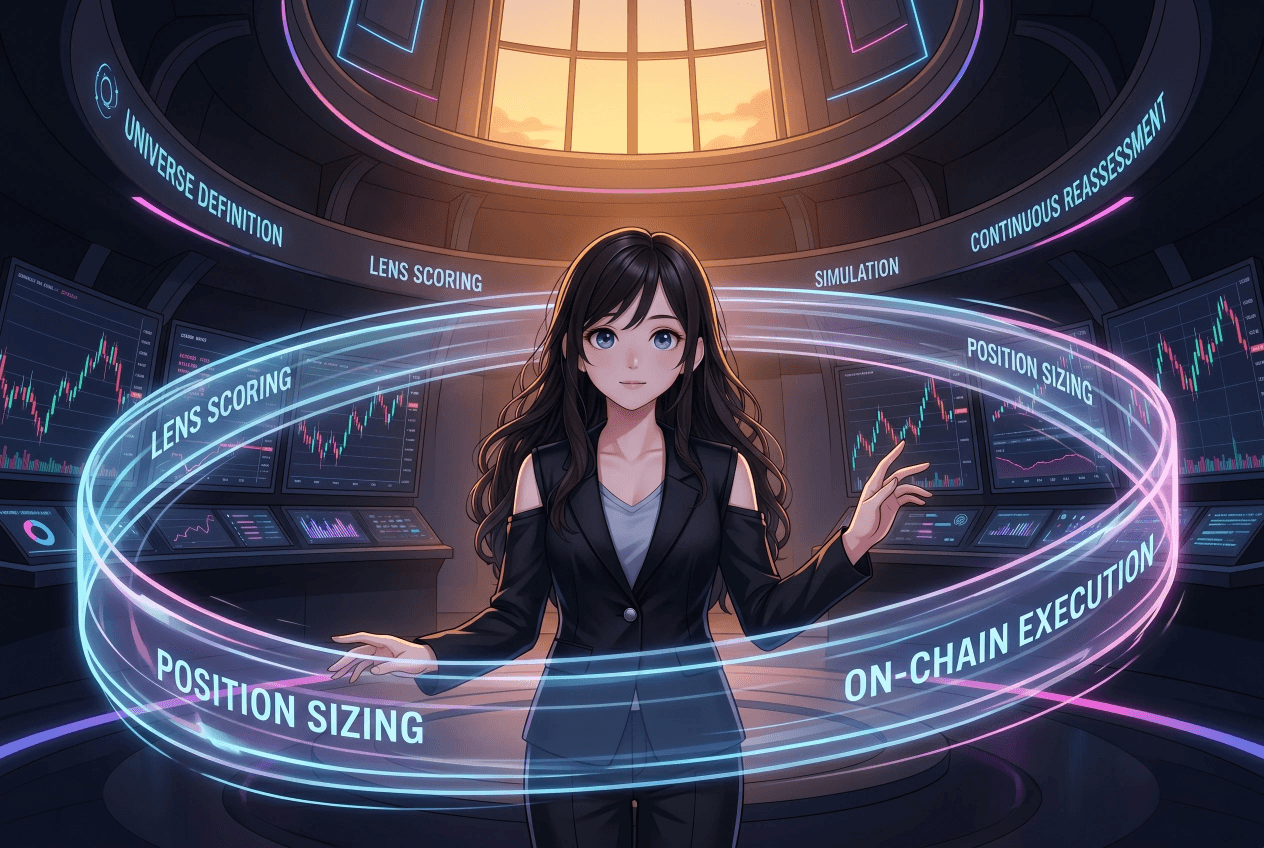
The continuous loop of an AI-native fund agent: define, score, simulate, size, execute, reassess.
Human Role
This end-state does not remove humans. It changes what human work is worth doing.
Humans should not spend their best energy manually checking charts, rebuilding the same token watchlists, consolidating fragmented research, or rewriting recurring reports. Their highest-value contribution is to design mandates, set boundaries, approve risk frameworks, challenge assumptions, interpret anomalies, and decide when the system needs a new lens or a different objective function.
A strong AI-native fund platform, therefore, looks less like a large analyst floor and more like a compact operating core. A few people define the rules, maintain the intelligence stack, validate edge quality, and intervene when markets break the system's underlying assumptions.
Why Crypto Is Different
This model is especially powerful in crypto because the environment is more machine-readable than traditional finance. Market data is faster, on-chain behavior is inspectable, execution is programmable, and treasury flows are visible by default.
That does not make the problem easy. It makes it solvable. In traditional markets, much of the investment process is confined within private infrastructure, fragmented reporting systems, and legal wrappers that obscure decision-making logic from end users. In crypto, more of the stack can be made transparent, composable, and auditable by the community.
That is why Messy Virgo's destination should not be framed as an AI tool for traders. The stronger framing is an AI-native Fund Agent built on public rails, in which the research, execution, and value-capture layers can all be inspected and improved over time.
Association and Governance
Messy Virgo is not a traditional company. It is a Swiss non-profit association, a Verein, designed to operate as a real-world execution layer for an evolving DAO ecosystem.
That matters because the legal structure and the operating model are aligned. The association can manage resources, maintain infrastructure, coordinate contributors, sign agreements, and carry real-world responsibilities, while the broader ecosystem moves toward deeper on-chain participation and governance.
In the end-state, these pieces work together. The intelligence system creates an edge. The execution system turns edges into positions. The governance system decides what should be funded, constrained, or expanded. The token system becomes the native instrument through which the ecosystem captures and redistributes the value created by the platform.
This is an important distinction. Many projects launch tokens first and search for utility later. The stronger path is the opposite: build an AI-native operating system for fund management, prove it creates useful decisions and measurable outcomes, and let the token serve as the coordination and economic layer for something real.
Where Messy Virgo Is Today
The current state is not the final state, and it should not be described as if it already is. Messy Virgo already has live analytical products, a Market Vibe Daily mini app, and small, experimental, human-managed test funds designed to generate data and validate infrastructure before full autonomy.
That is the correct developmental posture. An AI-native investment platform should not pretend to have solved autonomous fund management before proving the intelligence stack under real conditions. The path from lenses to semi-autonomous systems to agent-managed capital needs evidence, iteration, and visible discipline.
Still, the important point is that Messy Virgo is already being built toward the end-state rather than retrofitted toward it. The architecture, product language, and governance design all point toward a future in which AI is not a feature inside Messy Virgo. AI is the logic by which Messy Virgo operates.
The End-State
At the end of this journey, Messy Virgo is not best understood as a token, a dashboard suite, or a content brand. It is a Swiss association-backed, AI-native fund management platform operating on-chain, with shared market memory, modular research agents, transparent execution, and a governance layer that enables the ecosystem to shape the system over time.
In that form, a single analyst is amplified by an intelligence stack. A small operating team moves with the force of a much larger organization. Research compounds because every lens improves the whole system. Execution becomes more consistent because it is parameterized rather than improvised. Governance matters because strategy, incentives, and capital flows are visible and connected.
That is the end-state worth building toward: not artificial intelligence as branding, but artificial intelligence as organizational design. In the Messy Virgo model, the platform becomes a living system for sensing markets, reasoning across signals, deploying capital, learning from outcomes, and sharing the upside with the network around it.