If AI Can Build Anything, Why Isn't Everyone Rich?
There is a fake MIT Technology Review cover that circulates in AI circles with a brutal headline about AI, money, and bad ideas. It is a joke, but it captures a real feeling in the market.
AI has made it much easier to build software, automate tasks, and launch products quickly. But an easier building process does not automatically mean better businesses. Many founders can now ship fast using the same models, APIs, and tools. That means the hard part is no longer just building. The hard part is building something that makes money, becomes harder to copy, and fits deeply into real work.
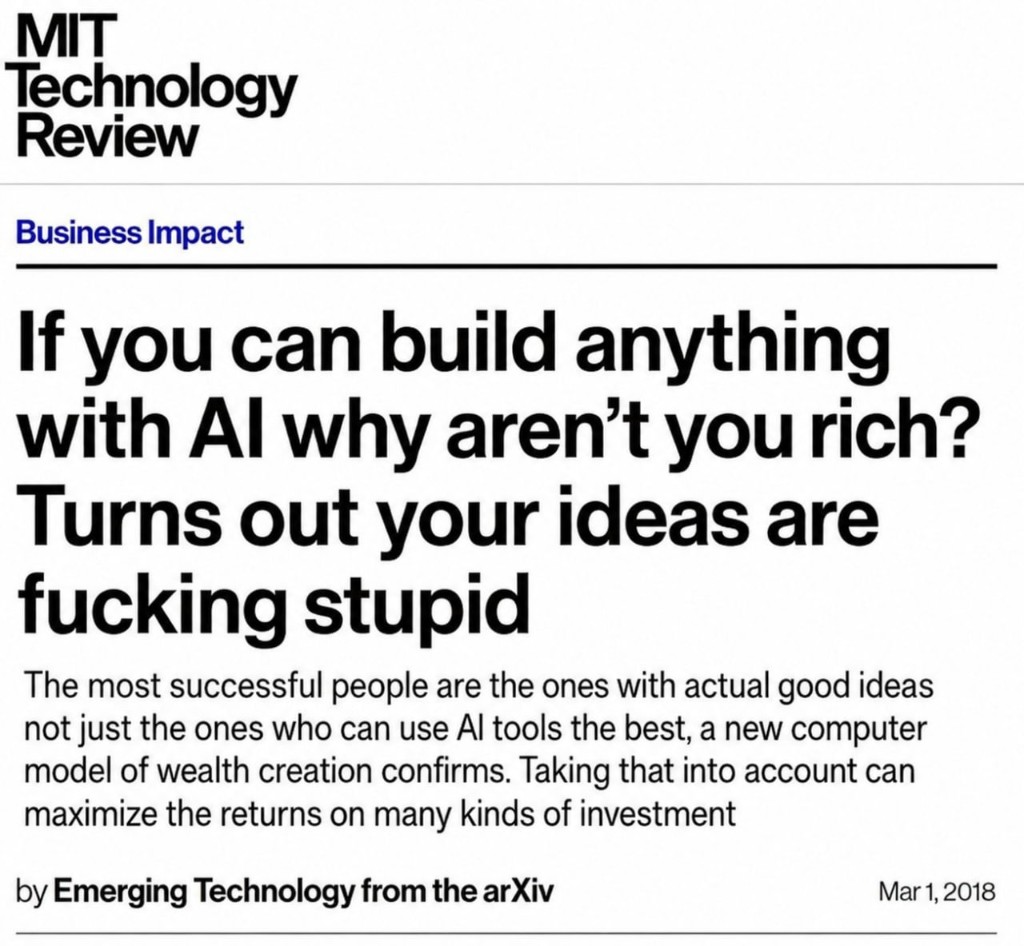
The joke headline captures a real question: if building got easier, why isn't everyone winning?
While building Messy, an AI-augmented on-chain fund, this stopped being a theoretical question. The challenge was not whether AI could help with research, automation, and execution. The challenge was whether it could be used to create a real business rather than just an impressive demo.
This is the simple checklist that emerged from that thinking.
1. Avoid the margin trap
A lot of AI products look impressive in a demo, but get weaker when you look at the economics. If too much of the value flows to model providers and infrastructure vendors, growth can become expensive instead of healthy.
The key question is simple: Is AI a powerful input into the business, or is the business mostly reselling expensive model output?
At Messy, this is the lens used to think about infrastructure, model usage, and how much of the value created actually stays inside the product and strategy.
A few useful checks:
- Does revenue grow faster than model and infrastructure costs?
- Could the product still work if premium model usage had to be reduced?
- Are model calls tied to clear value, or just used because they look impressive?
- Is the system getting more efficient over time?
If the product becomes more profitable as usage grows, that is a good sign. If usage grows but margins stay weak, that is a warning.
2. Build a scarce layer
Using AI is not a moat. If many teams have access to the same models, then simply being “AI-powered” is not enough.
The better question is: what gets harder to copy every quarter?
That scarce layer could be:
- Proprietary data.
- A trusted distribution channel.
- Internal systems that improve with use.
- A workflow that becomes deeply embedded in the customer's operations.
At Messy, this is the question behind every decision about data, process, and product design. The goal is not to sound advanced. The goal is to make sure the business compounds something that other teams cannot easily reproduce.
Early on, most startups will not have a perfect answer here. That is normal. What matters is choosing a path where defensibility can grow through execution.
3. Own a workflow, not just a feature
Many AI products help with one step of a task. Fewer products own the full job.
That distinction matters. A feature can be useful and still easy to replace. A workflow product can become important because it connects multiple steps, reduces handoffs, stores context, and helps produce a real outcome.
For founders, the useful question is not just “what can the model do?” It is “what job is the customer trying to complete, and how much of that job can this product own?”
This is especially important for Messy. The ambition is not to bolt AI onto a single research screen or a single signal dashboard. The ambition is to own the full job of running an on-chain strategy, from research and selection to execution, monitoring, and reporting.
A strong workflow product usually does more than generate suggestions. It helps move work from input to decision to action.
A simple quarterly check
Once a quarter, sit down and score the business in three areas:
| Area | Healthy direction | Warning sign |
|---|---|---|
| Economics | Costs become a smaller share of value over time | Usage grows, but margins stay weak |
| Defensibility | The product gets harder to copy every quarter | The edge still comes mostly from public models |
| Workflow depth | The product owns more of the customer's job over time | The product remains a point solution |
This does not need to be complicated. A simple 1-to-5 score in each category is enough if the discussion is honest.
This is also where the checklist is especially useful for Messy. It provides a simple way to assess whether the product is becoming a real operating system for a fund or drifting toward hype, complexity, or shallow automation.
Final thought
AI is real leverage, but it is not a strategy by itself. Early founders do not need perfect answers on day one. They do need to stay honest about whether they are building a business with improving economics, real defensibility, and deeper ownership of a workflow that matters.
That is the real reason this checklist matters to Messy. It is not content for content's sake. It is a public version of the framework used internally to stay disciplined while building an AI-native investment product in a noisy market.
Messy is an AI-augmented crypto fund being built around that discipline. If that way of thinking resonates, more writing like this will follow.
Sources and further reading
- Ed Zitron – "Why Everybody Is Losing Money On AI"
- Chris Dunlop – "Why has AI not made us all rich yet"
- Jerry Neumann – "AI Will Not Make You Rich"
- Why AI Wealth Will Be Made Downstream, Not Upstream
- On AI: the Age of Extremes
- Why AI isn't showing up on your bottom line
- Why Every AI Workflow Is Really a Data Problem in Disguise
- The Numbers Behind Training, Inference, and Chat