State of the Stack: Who Owns the Future of AI-Driven Crypto Funds?
By Messy Virgo — June 12, 2026
The DeFAI narrative exploded in 2025. AI agents began trading on-chain, narrative bots moved markets, and every protocol started adding "AI-powered" to its pitch deck. A year later, the dust is settling, and a clear pattern is emerging.
Most of what was built is just one layer of a much bigger stack. Nobody has connected the layers end-to-end. That gap is the most important structural opportunity in crypto right now, and it's closing fast.
The Market Has Already Spoken
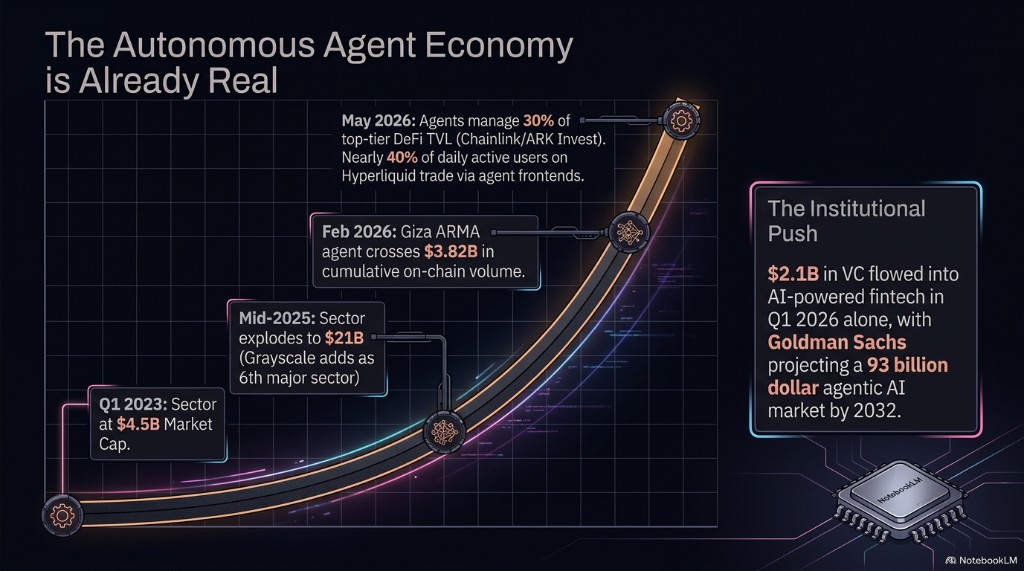
The numbers are not speculative. The AI crypto sector grew from a $4.5 billion market cap in Q1 2023 to over $21 billion by mid-2025, a roughly fivefold increase in just over two years. Grayscale officially added "Artificial Intelligence Crypto" as its sixth major crypto sector in 2025, placing it alongside DeFi and Layer 1 platforms as a structural pillar of the ecosystem.
By May 2026, autonomous AI agents were managing approximately 30% of TVL in top-tier DeFi pools, according to a report co-authored by Chainlink and ARK Invest. On Hyperliquid alone, nearly 40% of daily active users now trade through third-party agent frontends rather than the native UI. Giza's flagship autonomous agent, ARMA, had already generated $3.82 billion in cumulative on-chain volume as of February 2026, from a standing start.
The direction is unambiguous. What remains unresolved is who builds the full system.
The Stack Nobody Has Assembled
Run through what a serious AI-driven crypto fund actually requires, layer by layer:
| Layer | Function | Who Does It Today |
|---|---|---|
| Macro regime detection | Is the market risk-on or risk-off? What phase are we in? | Messari (partial), proprietary quant funds |
| Narrative momentum tracking | Which sectors and tokens are gaining mindshare? | Kaito AI, AIXBT |
| On-chain security signals | Is a token safe to allocate to? Contract risk, liquidity traps? | Forta, Cyfrin (standalone tools) |
| Research → scoring engine | Combining signals into an actionable conviction score | Nobody publicly |
| Allocation logic | Translating scores into position sizing and rotation decisions | Nobody publicly |
| Autonomous on-chain execution | Executing the fund on-chain without human intervention | Giza/ARMA (yield only), NEYRO (execution) |
Every incumbent owns one or two layers. Kaito owns attention data. AIXBT owns narrative detection and social reach. Messari has deep research. Giza owns autonomous DeFi execution. None of them connects all six.
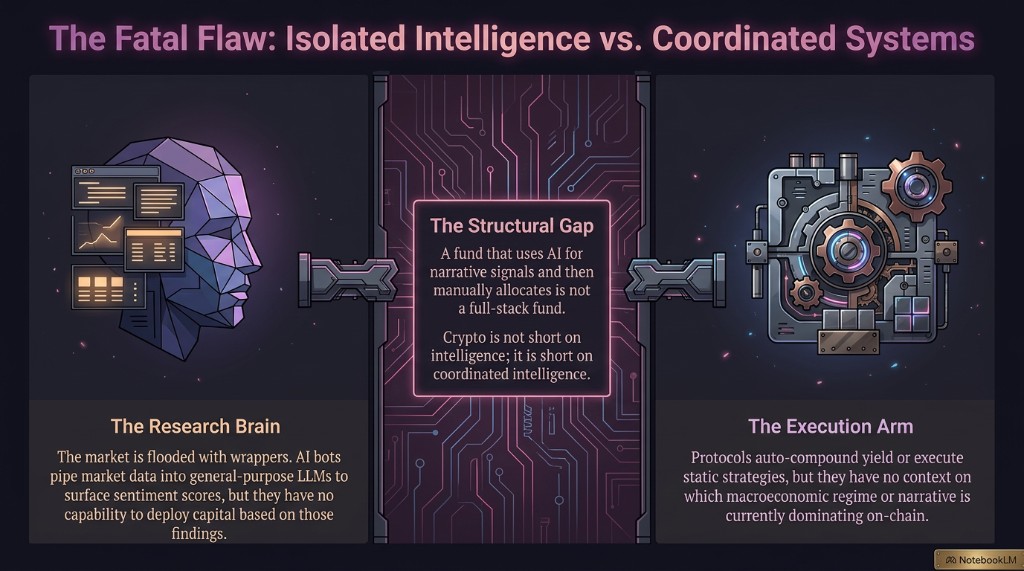
This is not a minor gap. The research and execution layers require fundamentally different competencies and trust models. Connecting them—with macro-regime context as the brain—is architecturally nontrivial. That is precisely why it hasn't been done yet.
Why the Window Is Real (and Measured in Years, Not Decades)
The infrastructure race is accelerating. Three data points frame the urgency:
Capital is pouring in. Over $2.1 billion in VC flowed into AI-powered fintech in Q1 2026 alone. Agentic AI startups raised a cumulative $9.8 billion across the top 100 companies tracked, with Andreessen Horowitz leading in deal count with 10+ transactions. The median time for an agentic AI startup to reach $100 million in cumulative funding fell to 18 months for 2024–2025 vintage companies.
Builders are converging on this category. 73% of investment-backed startups funded by Y Combinator between January 2024 and June 2025 were developing agentic AI systems. In YC's Spring 2025 batch alone, 67 out of 144 companies—nearly half—focused on agentic AI. Finance and crypto rank among the top targeted verticals.
The on-chain agent economy is already real. Goldman Sachs projects a 24-fold increase in agentic AI token consumption from 2026 to 2030. The agentic AI market is expected to reach $10.86 billion in 2026 and $93.2 billion by 2032. By 2030, Chainlink and ARK Invest project that AI agents could manage over 80% of DeFi's top-tier liquidity.
The window to establish a category-defining full-stack position is about two to three years. After that, well-funded teams, whether assembled from Bittensor subnets, DeFAI infrastructure protocols, or large asset managers with engineering capacity, will close the gap.
What "Full Stack" Actually Means
The distinction that matters is not AI vs. no AI. It's research brain vs. execution arm — and whether they speak the same language.
A fund that uses AIXBT for narrative signals and then manually allocates is not a full-stack fund. A protocol that auto-compounds yields in lending markets is not a fund. A quant model that optimizes a static portfolio has no idea which narrative is winning on-chain this week.
The full-stack AI fund requires:
- A macro layer that knows whether the regime favors risk assets or capital preservation
- A narrative layer that tracks which sectors are gaining attention and momentum
- A security layer that filters out allocations that carry unacceptable smart contract or liquidity risk
- A scoring engine that synthesizes these signals into conviction
- An allocation engine that sizes positions based on conviction, volatility, and correlation
- An execution layer that implements those decisions autonomously on-chain
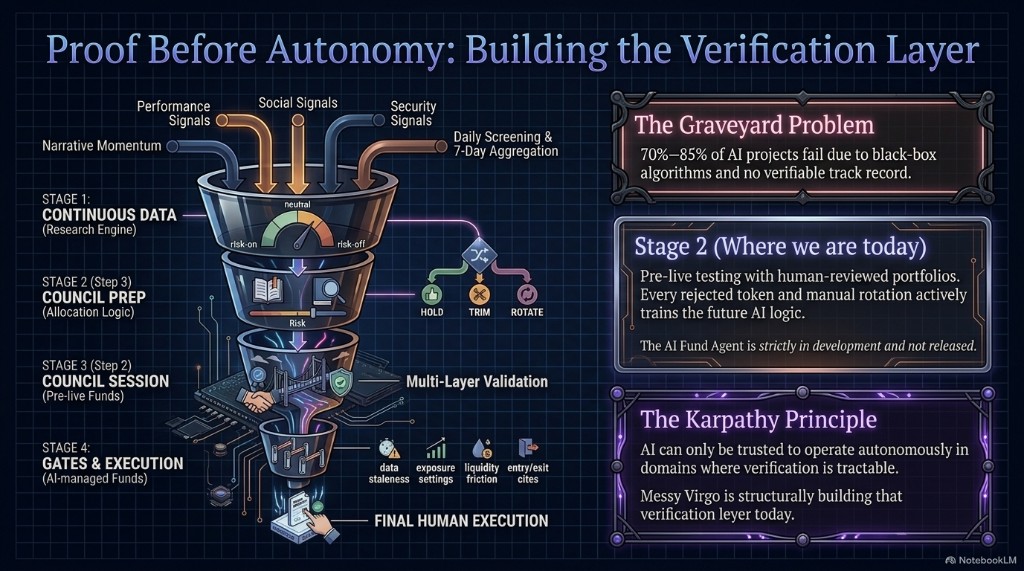
Each layer informs the next. Remove any one, and the system breaks down into a tool, useful but not a fund.
The Thesis
Crypto is not short on intelligence. It is short on coordinated intelligence—research, risk, and execution working as a single system rather than as isolated tools.
The teams that connect the full stack first will not just build a better product. They will define what an AI-driven crypto fund looks like for the next decade. Given that autonomous agents are already moving 30 percent of DeFi's top TVL and that the sector is on a trajectory toward a 93 billion dollar agentic AI market by 2032, the category being built here is not niche.
The stack is being built. The question is who assembles it first and whether they build it as a coherent system or a collection of parts.
Messy Virgo is building the full stack for AI-driven crypto fund management on Base. Follow the build at messyvirgo.com and @MessyVirgoCoin on X.
References
- AI Crypto Sector Joins Top 6 with $21B Market Surge - Binance
- AI crypto market surges 5x! Grayscale Research reveals sector growth
- AI Agents Now Control 30% of DeFi Liquidity. The Agentic Flip Is Here.
- Top 4 AI Trading Solutions Redefining On-Chain Execution in 2026
- Giza (@gizatechxyz) on X
- Kaito AI: A Comprehensive Analysis of the Web3 Intelligence Platform
- Messari (@MessariCrypto) on X
- AIXBT by Virtuals.io - Quicknode
- Top Agentic AI Startups by Fundraising (2026) - New Market Pitch
- 5 Hottest AI Finance Projects on GitHub in 2026 - Ultra Lab
- Y Combinator's 2025 Spring batch reveals the future of agentic AI
- YC's Spring '25 batch: 67 startups focus on agentic AI - LinkedIn
- Agentic AI for Finance: Workflows, Tips, and Case Studies - CFA Institute
- Agentic AI Statistics 2026 - Cyntexa
- AI Agents Forecast to Boost Tech Cash Flow as Usage Soars - Goldman Sachs
- Review of 2026 predictions: Part 1 AI x Crypto - LinkedIn
- Bittensor subnets: The best opportunities for investing in TAO
- Trading Agents: The Infrastructure Shift Reshaping DeFAI
- DeFAI and Intent: the future of decentralized finance (DeFi)?