Why Messy Virgo Is Built to Last: A Structural Analysis of Competitive Advantage
The market is filled with AI crypto projects, but most won't survive until 2027. Here is a precise diagnosis of why Messy Virgo stands apart and has a structurally higher chance of success.
The Graveyard Problem
Between 70% and 85% of AI projects fail to meet their original objectives, and that figure predates the current wave of AI crypto launches. The failure mode is rarely a lack of ambition. It is a failure of foundations: poor data governance, opaque governance structures, no verifiable track record, and business models built entirely on narrative inflation rather than demonstrable utility.
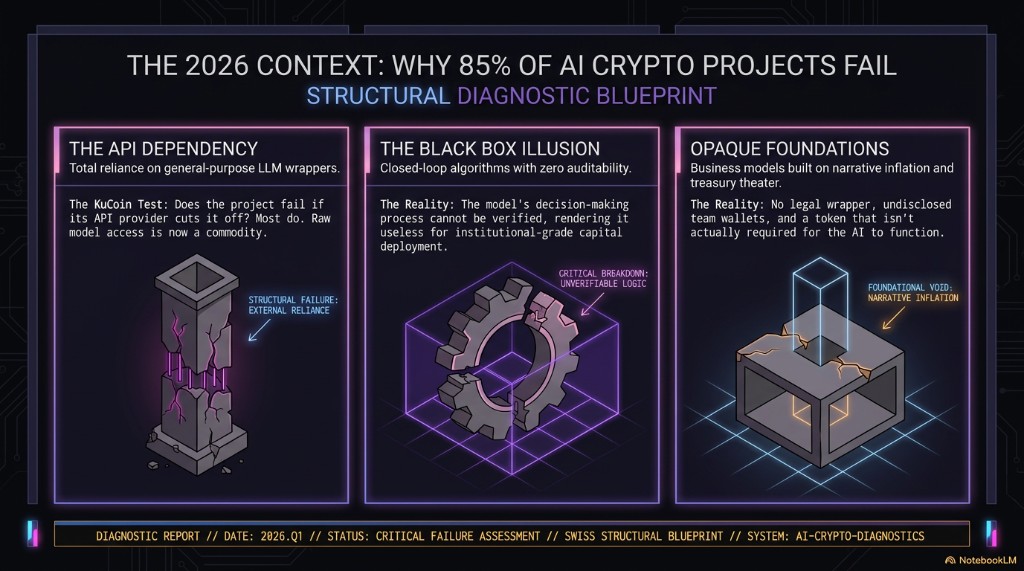
The AI crypto space in 2026 has amplified this problem. KuCoin analysts have identified a straightforward test for survival: does the project fail if its API provider cuts it off? Does the token need to exist for the AI to function? Are the algorithms a black box with no audit trail? Most projects fail all three. Messy Virgo is designed from the ground up to pass them.
Characteristic 1: Proof Before Autonomy — The Discipline No One Else Has
The single most distinctive structural feature of Messy Virgo is its insistence on publicly reviewed human testing before deploying autonomous capital.
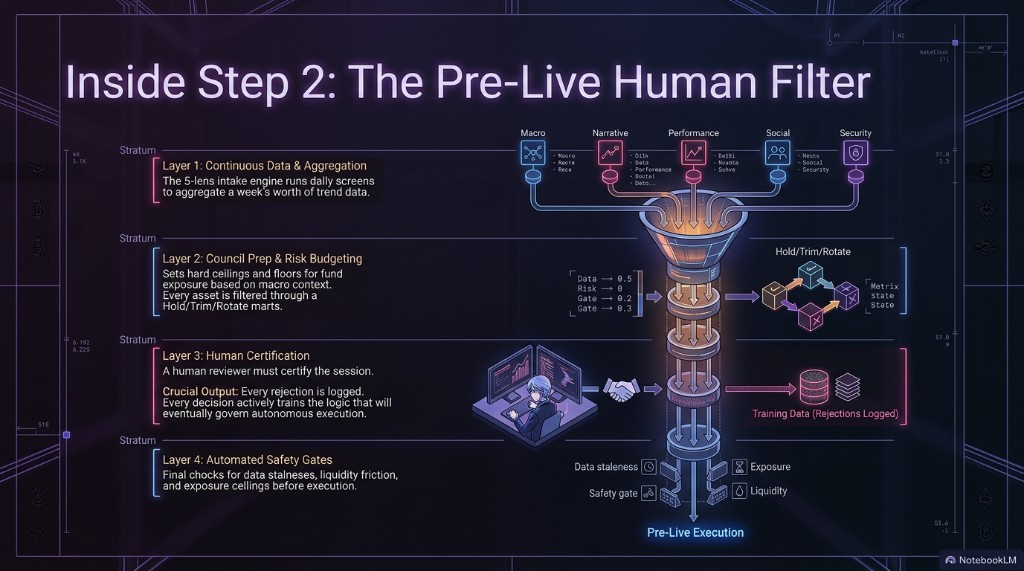
The roadmap is explicit and sequenced: Research Engine, Pre-live Testing Funds, Allocation Logic hardening, and AI-managed Funds. At step two, where most projects would declare victory and market a "live AI fund," Messy pauses. Every fund position is human-reviewed, every rejection is logged, and each decision is tracked publicly through fund updates, build logs, and the blog. The AI Fund Agent is explicitly labeled as in development and not released.
This is not timidity. It is the same logic Andrej Karpathy articulated at Sequoia's Ascent 2026 summit: AI can be trusted to operate autonomously only in domains where verification is tractable. Messy Virgo's pre-live testing phase is, structurally, the construction of that verification layer. Every win, loss, and rejection during human-reviewed testing actively trains the logic that will eventually govern autonomous execution.
The practical result: when the AI Fund Agent eventually launches, it will be backed by a documented, on-chain provable track record, not a pitch deck. In a market where trust is now part of the business model, that distinction is decisive.
Characteristic 2: The Five-Lens Research Engine as a Moat
Most AI crypto tools are wrappers. They pipe market data into a general-purpose LLM and surface a price prediction or a sentiment score. Messy Virgo's architecture is fundamentally different.
The research engine operates through five distinct sensory surfaces, each designed to answer a specific decision question that feeds the fund's screening and risk layer:
- Macro Economics and News — Regime context for exposure and risk posture
- Narrative Momentum — Thematic opportunity and crowding signals over a 30-day window
- Performance Signals — Trend quality and relative strength for candidate selection
- Social Signals — Attention quality and narrative risk, not just raw sentiment
- Security Signals — Contract-level no-go flags and liquidity risk rejection
This architecture reflects what researchers building multi-agent due diligence systems have independently converged on: specialist domains operating in parallel, with cross-referenced findings, produce qualitatively superior outputs compared to monolithic models. Messy's lens architecture is not derivative; it is the product of a deliberate design philosophy that treats repeatability, provenance, and graceful degradation as first-class system properties.
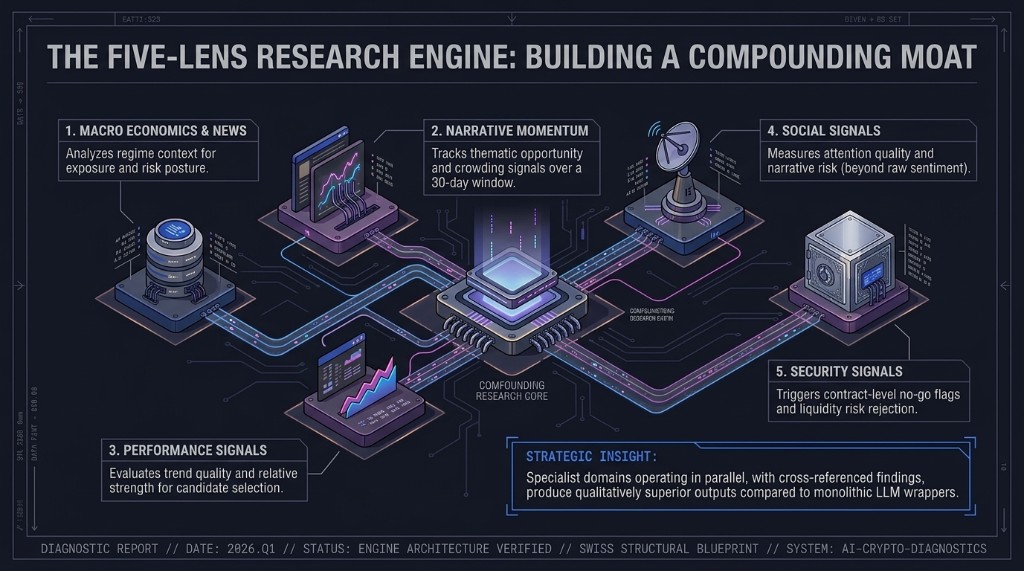
The moat this creates is compounding. Each daily screening run adds to an institutional memory of what worked, what was rejected, and why. As KuCoin's strategic analysis of the AI and Crypto landscape notes, the critical differentiator in 2026 is shifting from raw model access, which is now a commodity, to domain-specific feedback loops and verifiable data. Messy is building exactly that loop, systematically and publicly, one screening run at a time.
Characteristic 3: Institutional-Grade Legitimacy at the Community Layer
There is a structural gap in crypto that almost no retail-facing AI project has addressed: the gap between institutional-grade process rigor and accessible community participation. Messy Virgo is one of the few projects explicitly designed to close it.
The legal structure is a Swiss non-profit association (Verein) under the Swiss Civil Code Articles 60–79, registered in Zürich and incorporated on January 4, 2026. This is not a cosmetic choice. The Swiss Verein structure is the most community-aligned DAO legal wrapper available globally; it grants token holders direct membership rights, enables on-chain governance to map cleanly to an off-chain legal entity, and carries Switzerland's significant regulatory credibility. It is the same structure used by the Ethereum Foundation and other long-duration protocol stewardship organizations.
Layer onto this: a SolidProof smart contract audit that found no critical or medium issues; KYC completed for the team through SolidProof's verification process; renounced contract ownership (the owner cannot change any settings); and full treasury transparency with monthly on-chain movement reports. Every token allocation is held in six Safe smart wallets with publicly disclosed addresses. There are no undisclosed team wallets.
Research indicates that explainability and governance transparency are the primary trust factors for AI adoption, even more so than model accuracy. Messy Virgo's entire operational structure is built around this finding, not as a marketing afterthought, but as an architectural commitment.
Characteristic 4: The Democratization Thesis Is Structurally Sound
Institutional investors have long had access to sophisticated fund tools such as regime analysis, narrative momentum scoring, contract-level security screening, and portfolio allocation logic, which retail participants simply cannot access or afford. Messy Virgo's stated mission is to deliver exactly that toolkit to retail investors, packaged as a software-native product rather than a managed fund vehicle.
The timing is not arbitrary. Academic research from Washington University in St. Louis found that since ChatGPT's 2022 release, retail trading patterns have measurably converged toward institutional patterns, as AI demonstrably lowers information-processing costs and narrows the information gap. Messy Virgo's bet is that this dynamic accelerates dramatically when the AI tool is purpose-built for crypto portfolio management in the small- and mid-cap tiers rather than a general-purpose solution.
The specific focus on small and mid-cap crypto is itself a structural advantage. This is where information asymmetry is highest, where contract-level security risk is most dangerous, and where narrative momentum matters most to price discovery. These are exactly the conditions in which a systematic, multi-lens research engine creates the most differentiated signal, and exactly the conditions in which institutional players are least active, leaving a clear market gap.
Characteristic 5: The Build Log as Competitive Signal
Most crypto projects communicate through announcements. Messy Virgo communicates through proof.
The weekly build log, fund updates, and long-form blog serve as a public audit trail of operational competence, not a passive content calendar. Every shipped tool, every rejected token with its reason for rejection, and every macro regime assessment is documented. This creates something rare in crypto: a falsifiable track record.
In 2026's environment, where markets are asking harder questions about whether adoption is real or performative, a falsifiable track record is a strategic asset that compounds over time. The build log is not marketing collateral; it is evidence — the same evidence that will be cited when institutional partners, auditors, or community governance votes need to assess whether the process works.
This also maps directly onto what Karpathy calls the verifiability thesis: the domains where AI earns autonomy are those where you can verify the output without a human in the loop. Messy's build-in-public approach is constructing verifiability as an organizational practice before it is embedded in the autonomous system.
Characteristic 6: Swiss Governance as a Two-Layer Trust Architecture
The governance model at Messy Virgo is architecturally unusual in crypto. It separates strategic sovereignty (community token holders) from operational execution (the Swiss association) and defines explicit, tiered decision rights.
Routine operational decisions are handled by the board immediately. Strategic changes require a DAO vote after a discussion period. Major constitutional changes require higher thresholds and may require approval from both the DAO and the General Assembly. Financial signature authority follows the same logic: below CHF 25,000, a single board member; at or above that threshold, a joint signature of two board members is required.
This is not bureaucracy; it is the same governance design logic used in institutional fund management, where operational speed is preserved for routine decisions while capital deployment above certain thresholds requires independent sign-off. The result is a structure that can move fast on product execution while preserving the checks that prevent the treasury theater and governance failures that have destroyed better-funded crypto projects.
The Structural Advantage, Summed Up
Messy Virgo does not succeed because it has the most sophisticated AI. It succeeds because it has assembled the full stack of conditions that give an AI-powered fund product a durable right to operate: a proven-before-autonomous methodology, a compounding institutional memory architecture, the highest-trust legal wrapper available to a DAO, a falsifiable public track record, and a specific market gap — retail access to institutional-grade small-cap research — that no well-capitalized competitor is targeting.
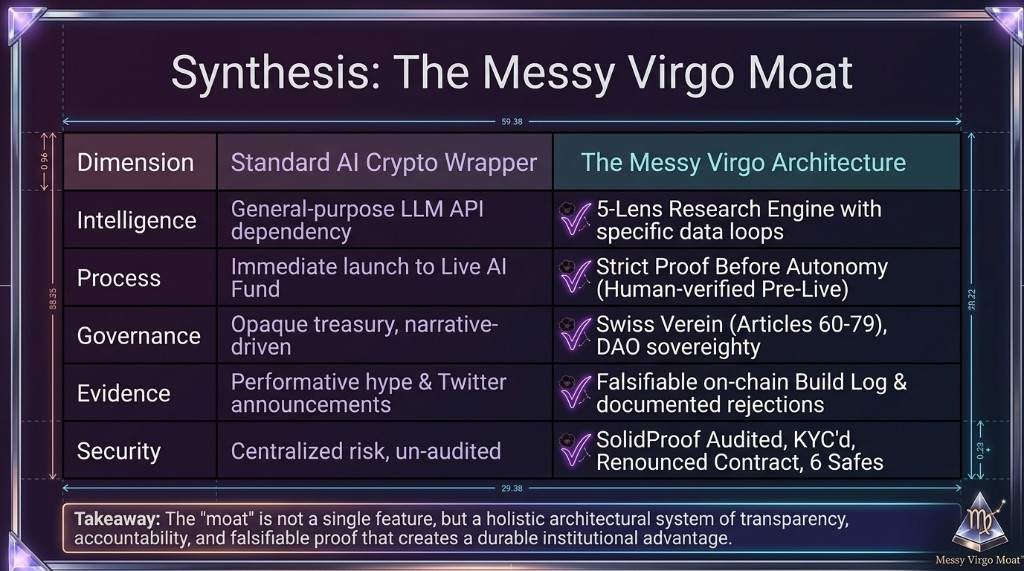
In a 2026 landscape where the question has shifted from "does the technology work?" to "does the business model justify the trust being asked of the market?", Messy Virgo's answer is unusually concrete. The proof is on-chain. The governance is auditable. The track record is public. Autonomy comes only after the process is proven.
That is what a higher rate of success looks like when it is built structurally, not promised narratively.