In a World Where AI Builds Everything, Trust Is the Only Moat
There's a question I don't think enough people in AI crypto are asking seriously:
If AI removes every barrier to building, who earns your lasting trust?
This is about your lasting trust, not just your attention or your first purchase. Trust that endures through a bear market, a rug pull, a narrative shift, three competitor launches, and a year of slow, unsexy building.
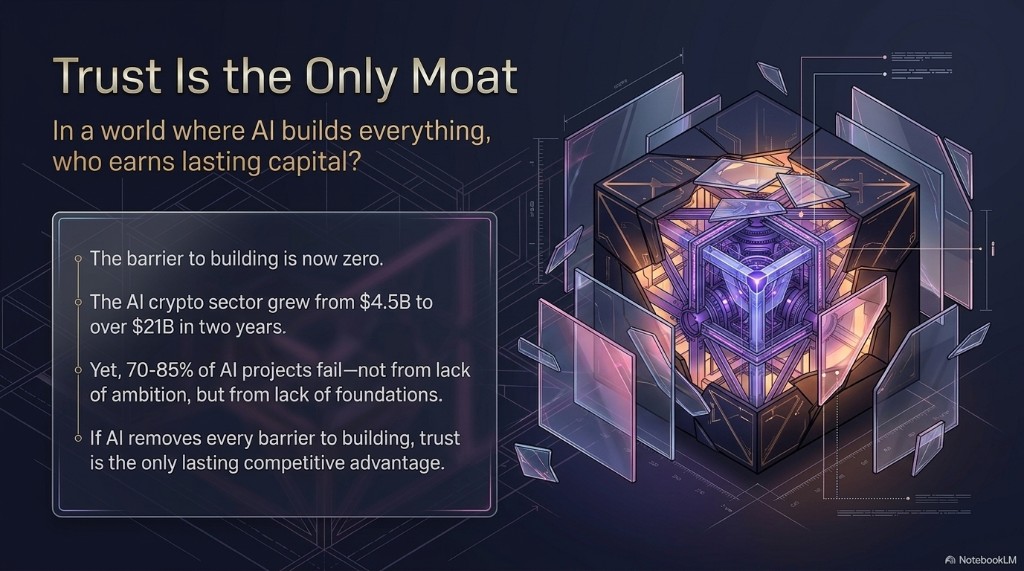
If building is free, the hard part is building something defensible.
I'm Franco, co-founder of Messy Virgo. Over the past few weeks, I published three pieces that together aim to answer this question honestly — covering the market opportunity, why we're building the way we are, and the internal discipline framework we use to ensure we stay on course. I want to walk you through them as a trilogy because they truly form a single whole.
Part 1: The Gap That's About to Get Expensive
State of the Stack: Who Owns the Future of AI-Driven Crypto Funds?
The AI crypto sector grew from $4.5 billion to over $21 billion in just over two years. Grayscale now lists "Artificial Intelligence Crypto" as one of six structural pillars of the ecosystem, alongside DeFi and Layer 1. Autonomous agents are already managing approximately 30 percent of TVL in top-tier DeFi pools. On Hyperliquid alone, nearly 40 percent of daily active users trade through third-party agent frontends rather than the native UI.
The direction is settled. What isn't settled is who builds the full system.
In this piece, I mapped the competitive landscape layer by layer — macro regime detection, narrative momentum tracking, on-chain security signals, a research-to-scoring engine, allocation logic, and autonomous on-chain execution — and looked honestly at every major player.
- Kaito AI owns attention data and narrative detection
- AIXBT owns social reach and narrative signals
- Messari has deep research infrastructure
- Giza/ARMA owns autonomous DeFi execution (yield only)
- Forta and Cyfrin cover standalone contract security tools
Each of them owns one or maybe two layers. Nobody connects all six end-to-end. The scoring and allocation layers — the ones that translate intelligence into actual fund decisions — are publicly owned by no one.
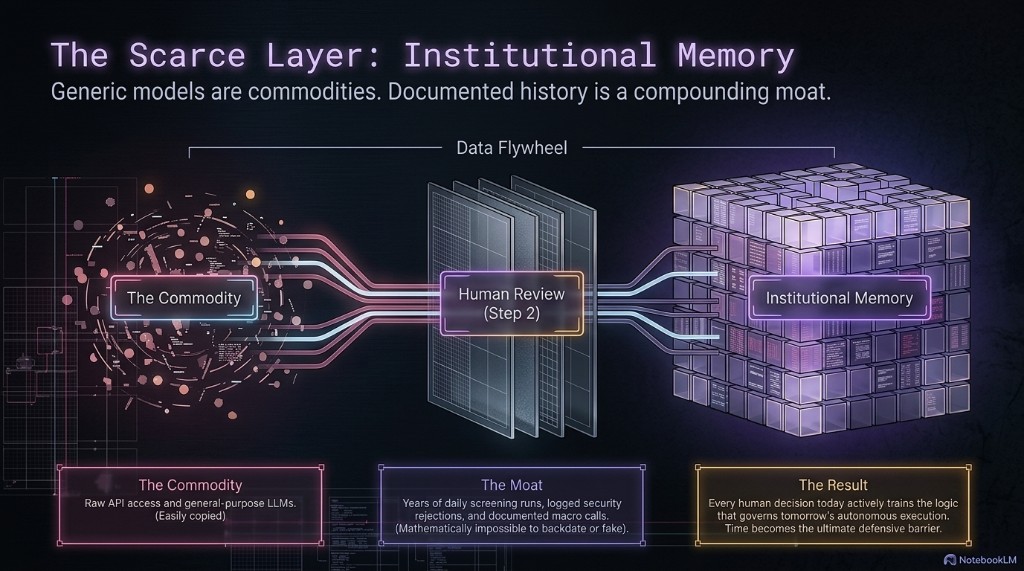
The moat is not model access. It is years of logged decisions that cannot be backdated.
Goldman Sachs projects a 24× increase in agentic AI token consumption from 2026 to 2030. The sector is projected to reach $93.2 billion by 2032. The window to establish a full-stack position is about two to three years before well-capitalized incumbents converge on it.
The question isn't whether the full stack gets built. It's who builds it as a coherent system rather than a collection of borrowed parts. That's the bet we're making with Messy Virgo.
Part 2: Why We're Building the Way We Are
Why Messy Virgo Is Built to Last: A Structural Analysis of Competitive Advantage
Between 70% and 85% of AI projects fail to meet their original objectives. That's not a crypto-specific number; it predates the current wave entirely. The failure mode is almost never ambition. It is foundations: opaque structures, no verifiable track record, business models built on narrative inflation, and single points of failure in the infrastructure stack.
KuCoin's analyst team offers a three-question survival test: Does the project fail if its API provider disappears? Does the token need to exist for the AI to function? Are the algorithms a black box with no audit trail?
We designed Messy Virgo to pass all three. This piece explains how.
The most important architectural decision we made is what I call "proof before autonomy." Most AI fund projects declare themselves live the moment they can generate a signal. Our roadmap is different: Research Engine → Pre-live Testing Funds (human-reviewed) → Allocation Logic hardening → AI-managed Funds. That pause at step two — where every position is human-reviewed, every rejection is logged, and every macro call is documented — isn't a delay. It's the construction of the verification layer that makes later autonomous operation trustworthy.
Andrej Karpathy put it well at Sequoia's Ascent 2026 summit: AI earns autonomy only in domains where verification is tractable. We're establishing tractable verification as an organizational practice before embedding it in the autonomous system.
Our five-lens research engine — macroeconomics, narrative momentum, performance signals, social signals, and security signals — isn't novel in concept. What's novel is that each lens generates compounding institutional memory. Every daily screening run adds to a record of what worked, what was rejected, and why. That record is the moat. Generic LLM wrappers don't build it.
The legal structure is a Swiss Verein under Articles 60 to 79 of the Swiss Civil Code, registered in Glattbrugg and incorporated on January 4, 2026. This is the same structure used by the Ethereum Foundation. Token holders have direct membership rights. On-chain governance maps clearly to an off-chain legal entity. The SolidProof audit found no critical or medium issues. Contract ownership has been renounced. Treasury movements are reported monthly on-chain. All allocations are held in six Safe smart wallets with public addresses.
None of this is flashy. All of it is expensive to replicate — not technically, but reputationally. You can't fake a year of documented decisions. This commitment to the structure signals a time horizon most projects don't have.
Part 3: The Discipline That Keeps Us Honest
If AI Can Build Anything, Why Isn't Everyone Rich?
This is the shortest and most direct of the three pieces. It asks a question I've been sitting with since we started building: if AI genuinely removes barriers to building, why isn't every AI startup printing money?
The answer I keep coming back to is that building is no longer the hard part. The hard part is building something that makes money, becomes harder to copy, and fits deeply into real work.
I published the three-part quarterly checklist we use internally to stay disciplined — not as a content exercise, but because making it public holds us accountable to it.
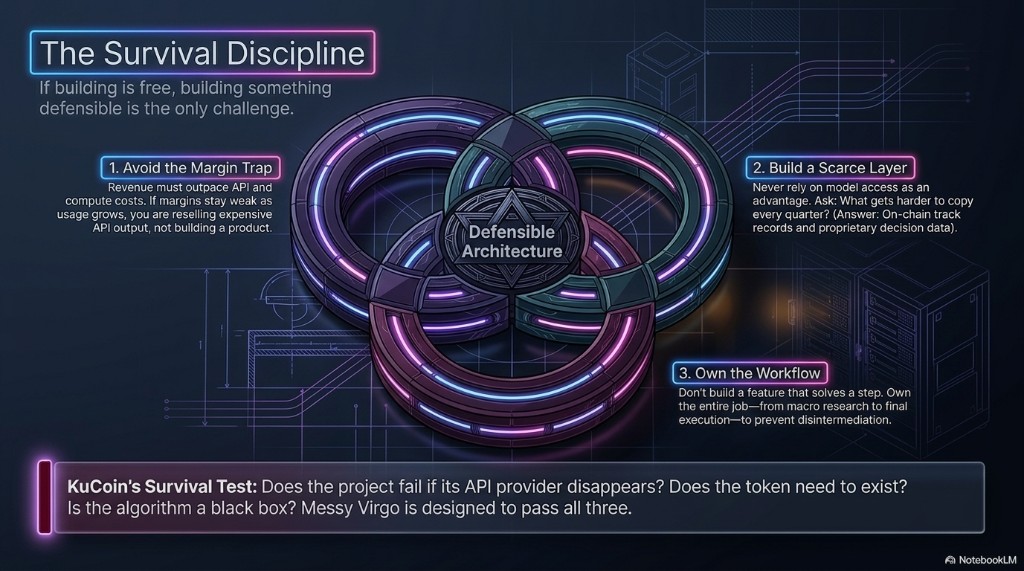
Messy Virgo is designed to pass KuCoin's survival test: no API dependency, token with purpose, no black-box algorithms.
Avoid the margin trap. Many AI products look great in demos but collapse on economics because too much value flows to model providers and infrastructure vendors. Our diagnostic: Does revenue grow faster than model and infrastructure costs? Could the product still work if premium model usage had to be reduced? If margins remain weak as usage grows, you're reselling expensive API output rather than building a product.
Build a scarce layer. Using AI is not a moat. Accessing the same models as every other team is not a moat. The useful question is: what gets harder to copy each quarter? For us, that's the institutional memory embedded in our growing archive of daily screening runs, the on-chain track record no one else is building yet, and the governance structure that gives allocators a reason to trust us at scale.
Own a workflow, not just a feature. A feature solves a step. A workflow owns the job. Our ambition is to own the full job of running an on-chain strategy — research, selection, execution, monitoring, and reporting — not to bolt AI onto a single screen or a signal dashboard.
Publishing this checklist publicly is the point. A team that documents its discipline framework is, by definition, accountable to that framework.
Why These Three Pieces Belong Together
The market opportunity is real and closing fast. The architecture to capture it sustainably is already being built. The internal discipline to avoid drifting from it is documented and public.
Most projects in this space have the first. Some gesture toward the second. Almost none have the third.
What I hope comes through in all three pieces is that the writing itself reflects the same standard we apply to fund decisions. The references — Karpathy at Sequoia, Washington University retail trading research, ARK Invest / Chainlink DeFi agent projections, Goldman Sachs agentic AI forecasts — aren't decoration. They're the scaffolding of a verifiable argument, built the same way we build the research engine: with sources you can check, logic you can follow, and conclusions you can dispute.
That's what coordinated intelligence looks like in practice. Not just smart systems, but systems that show their work.
We're building that system. Follow along at messyvirgo.com and @MessyVirgoCoin on X.